
ADR Limited Quantities (LQ) explained
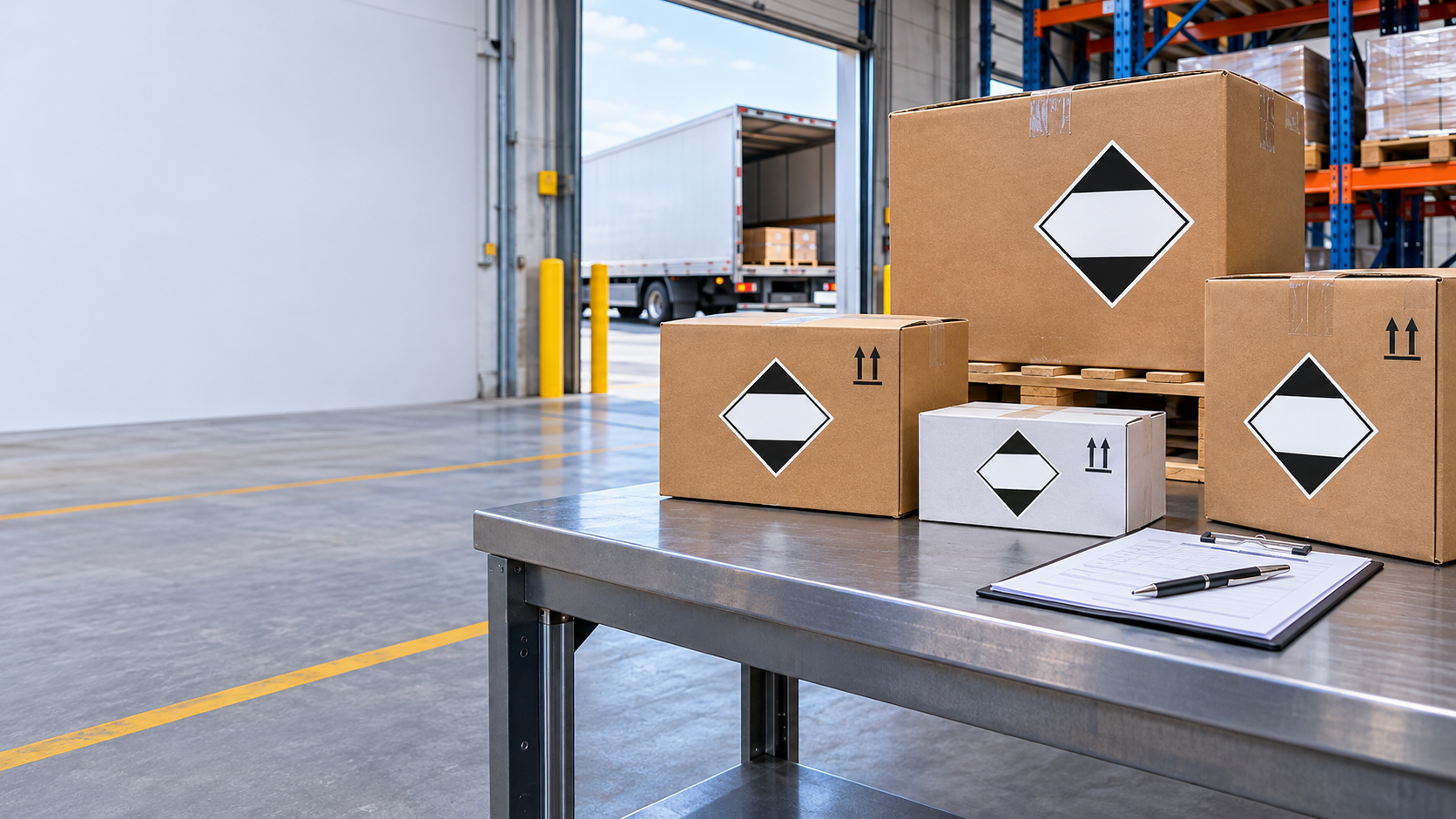
Transporting hazardous substances in small packages? Under the Limited Quantities scheme (LQ) of the ADR, less stringent transport regulations apply under certain conditions. But when may you apply this exemption, how much may you transport and which packages and markings are required?
The Limited Quantities scheme is widely used for transporting products such as paint, solvents, cleaning agents and spray cans. Although these products may contain hazardous substances, they do not always have to be transported according to all regular ADR regulations.
That does not mean that transport can take place without rules. The correct classification, packaging and marking remain essential.
What does Limited Quantities (LQ) mean within the ADR?
Limited Quantities (LQ) literally means limited quantities. It is a partial exemption for the transport of certain dangerous goods that are packaged in small amounts.
The legal basis is found in chapter 3.4 of the ADR.
The principle is that some dangerous substances, when they are transported in sufficiently small inner packings and suitable outer packings, may fall under a simplified regime.
As a result, various regular ADR obligations do not apply, while important safety regulations remain in force.
The LQ scheme is especially relevant for manufacturers, web shops, distribution centres, warehouses and transport companies that transport dangerous products in consumer packaging or other small packages.
When may dangerous substances be transported as LQ?
Not every dangerous substance qualifies for transport under the Limited Quantities scheme.
Whether LQ is allowed is determined based on the UN number and the corresponding entry in table A of chapter 3.2 of the ADR.
Column (7a) shows how much of the respective dangerous substance is allowed per inner packaging or item at most.
The column may, for example, contain the following values:
|
Entry in column 7a |
Meaning |
|
0 |
Transport as LQ is not allowed |
|
120 ml |
Maximum 120 milliliters per inner packaging |
|
500 ml |
Maximum 500 milliliters per inner packaging |
|
1 L |
Maximum 1 liter per inner packaging |
|
5 L |
Maximum 5 liters per inner packaging |
|
1 kg |
Maximum 1 kilogram per inner packaging |
These values are examples of possible limits and do not automatically apply to all hazardous substances.
The amount in column 7a is decisive. When an inner packaging contains more than the allowed LQ amount, that packaging may not be transported according to chapter 3.4.
Example: UN 1090 Acetone
Acetone is a flammable liquid that falls under UN 1090. According to the ADR substance list, the LQ limit for UN 1090 is a maximum of 1 liter per inner packaging.
A box with twelve tightly sealed 500 ml acetone bottles can therefore fall under the LQ scheme, provided that the other regulations are also met.
A single 2‑liter bottle of acetone, on the other hand, does not fall under this LQ limit, even when that bottle is packed separately in a box.
Which packaging rules apply to ADR Limited Quantities?
One of the main conditions for LQ transport is the use of suitable packaging.
In principle, hazardous goods must be packed in inner packaging placed inside a suitable outer packaging.
An inner packaging can, for example, be a bottle, can or plastic holder. The outer packaging is, for example, a sturdy cardboard box.
For certain items, such as spray cans, exceptions apply to the requirement to use a separate inner packaging.
Maximum gross mass per colli
The ADR distinguishes between ordinary composite packaging and trays that are wrapped with shrink or stretch film.
| Packaging type | Maximum gross mass |
| Suitable outer packaging, for example a cardboard box | 30 kg |
| Tray with shrink film or stretch film | 20 kg |
This concerns the total gross mass of the package, therefore including the dangerous goods and the packaging materials.
The limit of 30 kilograms does not mean that each bottle may contain 30 kilograms. For each inner packaging the separate LQ limit from column 7a remains applicable.
Furthermore, packaging must provide sufficient protection against leakage, damage and loss of contents under normal transport conditions. Dangerous substances that can react dangerously with each other may not be packed together without further measures.
Additional requirements for intermediate packaging apply to certain fragile inner packagings and corrosive liquids.
Which LQ mark must be on the packaging?
A package containing hazardous substances under the Limited Quantities scheme must be marked with the prescribed LQ label.
This mark consists of a diamond-shaped marking with a black top and bottom and a white or contrasting middle section.
The following basic conditions apply for road transport:
- The LQ mark is normally at least 100 × 100 mm.
- If the dimensions of the package make this necessary, the mark may be reduced, provided it remains clearly visible and is not smaller than 50 × 50 mm.
- The mark must be easily readable and sufficiently resistant to weather influences.
The LQ mark is not a regular ADR hazard label such as class 3 or class 8. It makes clear that the concerned package is transported under the simplified regime of chapter 3.4.
Do trucks carrying LQ goods have to have orange ADR plates?
When transporting only correctly packaged Limited Quantities, the usual orange ADR signs are not required.
However, for larger quantities of LQ goods a separate marking obligation for vehicles or containers may apply.
According to ADR 3.4.13 to 3.4.15 this requirement generally applies to transport units with an allowed maximum mass of more than 12 tonnes that transport more than 8 tonnes gross mass of LQ packages.
In that case LQ marks are required on the front and rear of the transport unit. Specific rules apply to containers for marking on the four sides and the visibility of the marks.
The LQ labels for vehicles and containers have a minimum size of 250 × 250 mm.
When other dangerous goods are also transported that require orange plates or large labels, the overlap rules from ADR 3.4.13 apply.
How many Limited Quantities may you transport at most?
A common misunderstanding is that under the LQ scheme up to 1,000 points or a certain total amount of hazardous substances may be transported.
For LQ goods only, chapter 3.4 does not specify a general maximum quantity per transport unit.
The main quantity restrictions relate to the individual inner packings and the maximum gross mass per package.
For larger quantities transported, additional requirements may apply, such as the vehicle and container marking described above.
The applicable regulations for safely loading, pushing, securing and transporting the goods also remain in effect.
Is an ADR transport document required for LQ transport?
When only hazardous goods that fully comply with chapter 3.4 are transported, the regular ADR transport document is not required according to ADR 5.4.1.
That does not mean that the carrier does not need any information.
According to ADR 3.4.12, the sender must inform the carrier before transport in a traceable manner about the total gross mass of the dangerous goods offered as Limited Quantities.
This can be done, for example, via the transport order or an electronic message, provided the information is traceable.
In addition, a carrier may request additional information for the acceptance and handling of shipments.
Does a driver need an ADR certificate for LQ transport?
A driver who only transports dangerous goods that correctly fall under chapter 3.4 generally does not need an ADR driver certificate according to ADR 8.2.1.
However, the general training obligations do not disappear entirely.
ADR 1.3 still applies. Persons involved in the transport of hazardous goods must be trained according to their responsibilities. Read more about such a training in e‑learning format.
This may include drivers, warehouse staff, order pickers, packers, loaders and personnel preparing transport documentation.
They must know how LQ packings are identified, which regulations apply to their tasks, and how unsafe situations can be prevented.
Is an ADR safety adviser required for the transport of Limited Quantities?
For companies that only carry out activities with dangerous goods that meet chapter 3.4, the Netherlands provides an exemption from the obligation to appoint an ADR safety adviser.
This exemption follows from ADR 1.8.3.2 and its Dutch implementation.
That means that a company that only ships, transports, packs, loads or unloads correctly packaged LQ goods generally does not need to appoint an ADR safety adviser.
As soon as a company also handles or transports other dangerous goods, it must reassess whether a safety adviser is required.
Therefore it is important not only to look at one transport shipment, but at all relevant activities of the company.
Common mistakes with Limited Quantities
Although the LQ scheme simplifies transport, errors regularly occur in practice.
Using an incorrect LQ limit. Companies assume that any hazardous substance in a package of up to 5 liters may be transported as LQ. The correct limit must, however, be checked per UN number.
Exceeding the maximum gross mass. A box may meet the limit per inner package but still be heavier than the allowed 30 kilograms.
Forgetting the LQ label. A correctly assembled package is not sufficient when the required marking is missing.
Insufficient protection against damage. Even for LQ transport, packages must be suitable and the load must be secured safely.
Failing to inform the carrier. The sender must provide the total gross mass of LQ goods in a traceable way in advance.
Thinking that LQ is completely exempt from the ADR. Various regulations still apply, including the relevant safety obligations and training requirements.
Frequently asked questions
What does LQ mean for hazardous substances?
LQ stands for Limited Quantities, i.e., limited amounts. It is a partial exemption for certain hazardous goods that are transported in small packages according to chapter 3.4 of the ADR.
How many liters may you transport as LQ?
That varies per hazardous substance. The allowed amount per inner packaging is listed in column 7a of table A of the ADR. Some substances may not be transported as LQ.
Is an LQ sticker mandatory?
Yes. Packages that are transported according to chapter 3.4 must in principle be provided with the prescribed LQ mark.
May you transport more than 1,000 points of LQ?
The 1,000-point rule is not the basis for determining the allowed amount of LQ goods. For exclusively LQ transport there is no general limit of 1,000 points. However, the packaging conditions and possibly vehicle marking requirements do apply.
Do you need an ADR certificate for LQ transport?
For exclusively correctly packaged LQ goods the ADR driver certificate is in principle not required. The applicable training obligation according to ADR 1.3 remains in effect.
Does a company need an ADR safety advisor for LQ?
In the Netherlands companies that exclusively carry out activities under chapter 3.4 are in principle exempt from the obligation to appoint an ADR safety advisor. For other hazardous substance activities it must be reassessed whether that obligation applies.
Arrange today your external ADR safety advisor
Do you want to organize your ADR obligations properly without hiring a safety advisor?
ADR Safety Advisors offers an affordable solution for in-house drivers and small transport companies.