
Liability in ADR road transport
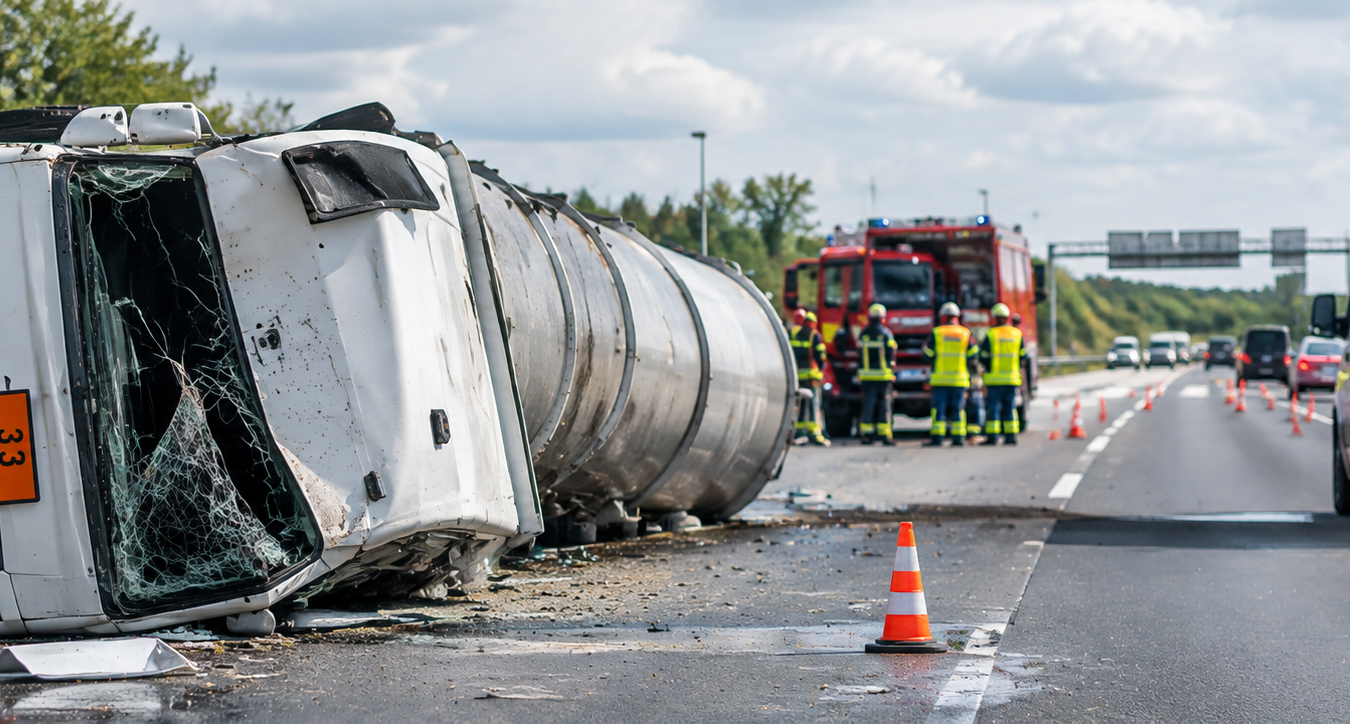
Who is liable when an accident occurs during the transport of hazardous substances? Which insurances must an ADR carrier have and is the legally required coverage of € 10 million sufficient?
When hazardous substances are transported by road, accidents can have major consequences. A leaking tanker, a burning truck carrying chemicals, or a damaged package can lead to personal injury, environmental damage, and significant property loss.
For transport companies and owner‑operators it is therefore important not only to comply with ADR regulations but also to understand the statutory liability and the required insurances.
In the Netherlands special liability rules apply to the transport of hazardous substances. In addition, the Motor Vehicle Liability Insurance Act (WAM) sets specific requirements for insurance coverage.
Which insurances are mandatory for ADR transport?
For ADR carriers, two statutory insurance obligations are particularly important: the regular third‑party liability insurance for motor vehicles and, for certain heavier vehicles, an additional coverage for liability due to hazardous substances.
The statutory minimum insured amounts are:
- Regular WAM – personal injury: € 6,450,000 per incident
- Regular WAM – property damage: € 1,300,000 per incident
- Additional WAM – hazardous substances coverage for motor vehicles over 3,500 kg: € 10,000,000 per incident
The special coverage of € 10 million is in addition to the regular WAM insurance obligations. It concerns various insured liability risks.
The statutory minimum is also not the same as the maximum amount for which a company can be liable under all circumstances.
When is the € 10 million insurance mandatory?
Article 3a of the Motor Vehicle Liability Insurance Act stipulates that the insurance for motor vehicles with a maximum permissible weight of more than 3,500 kilograms must also cover the legally defined liability of the operator for damage caused by a hazardous substance on board.
Article 2a of the Decree on amounts of motor vehicle liability insurance sets the minimum insured sum for this at:
€ 10.000.000 per event.
This additional insurance is not solely intended for damage caused by a traffic accident.
Also an incident with hazardous substances on board a stationary vehicle can fall under the special liability scheme.
Think, for example, of a tanker truck parked on a business premises where hazardous substances are released due to an incident.
Does the obligation also apply to vans?
For motor vehicles with a maximum permissible weight of 3,500 kilograms or less, the specific obligation from article 3a WAM does not apply.
That does not mean that a van with hazardous substances cannot cause damage or that the company does not face liability risk.
The regular statutory insurance obligation remains in place. In addition, it must be examined whether additional insurance coverage is needed.
Also the classification of the hazardous substance, the quantity and the transport conditions can be relevant when assessing liability and coverage.
Who is liable in an accident involving hazardous substances?
In an incident during ADR transport, various parties can be involved.
The ADR distinguishes, among others, the sender, carrier, packer, loader, filler, unloader and consignee.
Each party has its own safety obligations.
Thus the sender must, among other things, ensure the correct classification and the required information. The carrier must, among other things, check whether the prescribed transport information is present and whether the transport may take place based on the available information in accordance with the applicable ADR regulations.
The filler, loader and unloader also have specific obligations associated with their tasks.
How high can liability in ADR transport reach?
Under the special statutory liability scheme for hazardous substances, liability limitations may apply.
The Implementation Decree on liability for hazardous substances and environmental pollution sets the following amounts for the operator of a vehicle.
|
Liability |
Limitation amount |
|
Death or personal injury |
7,2 miljoen SDR |
|
Other damage |
4,8 miljoen SDR |
|
Personal injury under the liability referred to in article 6 paragraph 2 from other causes |
18 miljoen SDR |
|
Other damage under the liability referred to in article 6 paragraph 2 from other causes |
12 miljoen SDR |
SDR stands for Special Drawing Right, an international unit of account of the International Monetary Fund.
The value of the SDR relative to the euro changes. Therefore the amounts cannot be presented as fixed euro amounts without further qualification.
Liability limitations also do not apply in the same way in every situation. The applicable liability basis, exceptions and legal conditions are decisive.
An insured sum of € 10 million is therefore not automatically sufficient to cover all possible liability risks.
Which additional insurances are advisable for ADR carriers?
In addition to the legally required WAM insurance, transport companies may need additional insurances.
These are not all legally mandatory, but can be important to limit financial risks.
Carrier liability insurance (CMR/AVC)
A cargo liability insurance can cover liability for loss or damage to transported goods.
In international transport this insurance is often called CMR insurance.
For ADR carriers it is important that the policy matches the actually transported hazardous substances and the nature of the transport activities.
Check, for example, whether special conditions apply for flammable liquids, gases, toxic substances or tank transport.
The insurance for the transported goods is somewhat different from the special liability coverage for damage caused by hazardous substances to third parties.
Environmental damage insurance
An incident involving hazardous substances can lead to extensive environmental damage.
A leak can, for example, cause contamination of soil, surface water or the sewer system. The costs for controlling and cleaning up an incident can be considerable.
An additional environmental damage insurance or suitable liability coverage can therefore be important.
Pay attention to the distinction between damage to third parties, contamination of own or leased sites, cleanup costs and public law obligations for restoration or prevention.
Not every environmental damage insurance covers all these risks.
Business liability insurance (AVB)
In ADR activities damage can also arise outside the direct traffic risk.
Think of an incident during work at a loading site or damage due to an error when skipping hazardous substances.
A business liability insurance can be relevant for this, but motor vehicle, transport and specific environmental risks may be excluded or limited.
The different insurances therefore need to be well coordinated with each other.
What happens if a carrier does not comply with the ADR?
A violation of the ADR regulations can have administrative, criminal and civil law consequences.
It can, for example, involve incorrect labeling, missing documents, unsuitable packaging or the use of a driver without the required ADR certificate.
In a loss case a violation can also be relevant for the liability question and the application of insurance terms.
This does not mean that every ADR violation automatically leads to the loss of insurance coverage.
In legally required WAM coverage, an injured party has special legal protection. Under certain circumstances an insurer that must compensate an injured party may subsequently seek recourse against the insured or another liable party.
Therefore it is important to know the terms, exclusions and any subrogation rights of the insurer.
What should an ADR transport company pay attention to in its insurance?
When taking out or renewing insurance it is wise not to look at the premium alone.
Check especially the following points:
- Insured amount: does the policy meet at least the statutory WAM requirements and is the total coverage appropriate for the scale of the risks?
- Type of hazardous substances: are the actually transported UN numbers, hazard classes and products included in the coverage?
- Mode of transport: is transport of packaged goods, tanker transport, bulk transport or transport with tank containers properly insured?
- Loading and unloading: does the policy provide sufficient coverage for the tasks the company performs itself?
- Environmental damage: which contamination, prevention, cleanup and remediation costs are covered?
- Territorial coverage: in which countries does the insurance apply and are there differing terms or statutory minimum requirements there?
- Exclusions and deductible: which damages remain the company's responsibility and when can the insurer claim subrogation?
- Subcontractors: are responsibilities and insurance arrangements in place when transport is carried out by other transport companies?
A written confirmation from the insurer about coverage for the actual ADR activities is valuable in this regard.
Conclusion: the right insurance is essential for ADR road transport
Transporting hazardous substances carries special liability risks. An incident can lead to large personal, material and environmental damage.
For certain heavy motor vehicles the Dutch WAM therefore requires an additional insurance coverage of at least €10 million per incident.
But merely meeting the statutory insurance minimum is not always sufficient. The actually transported substances, the transport activities, the possible environmental damage and the policy terms also deserve attention.
A good alignment between ADR compliance, risk analysis and insurance coverage helps transport companies limit unexpected financial consequences.
Need help with ADR obligations?
ADR-Advisors.eu supports owner‑operators and small transport companies in meeting their ADR obligations. We assist, among other things, with the deployment of an external ADR safety advisor, the annual ADR safety report, and the assessment of safety obligations.
Frequently asked questions about liability and insurance
Is a €10 million insurance mandatory for ADR transport?
For motor vehicles with a maximum permissible weight of more than 3,500 kilograms, article 3a WAM imposes a special insurance obligation for the legally defined liability for hazardous substances on board. The legal minimum is €10 million per incident.
Is a regular third‑party liability insurance sufficient for transporting hazardous substances?
Not always. For vehicles to which article 3a WAM applies, the special liability for hazardous substances must also be covered. In addition, supplementary insurance for cargo, environmental damage and other business risks may be needed.
Can an ADR carrier be liable for more than €10 million?
Yes. The minimum insurance coverage and the statutory liability are two different matters. Depending on the liability basis and the circumstances, higher amounts can be relevant.
Is environmental damage in ADR transport automatically insured?
No. Certain damage caused by hazardous substances falls under statutory liability coverages, but not every form of environmental damage, remediation or restoration is automatically fully covered.
Do owner‑operators also have to meet the insurance requirements?
Yes. In principle, the same legal insurance requirements apply to owner‑operators as to other companies that transport hazardous substances with comparable vehicles.
Does the insurance lapse in an ADR violation?
Not automatically. The consequences depend on the statutory WAM protection, the policy terms and the circumstances. An insurer may, under certain conditions, have a right of recourse.
Arrange today your external ADR safety advisor
Do you want to organize your ADR obligations properly without hiring a safety advisor?
ADR Safety Advisors offers an affordable solution for in-house drivers and small transport companies.